

If you’ve been hurt in a crash or a fall, you’ve probably been told some version of “these things take time.” That’s true, but it doesn’t help when medical bills are stacking up on the kitchen counter. The honest answer is that a Virginia injury settlement can take anywhere from a few months to a couple of years. The biggest factor usually isn’t the insurance company or the courts. It’s your body, and how long it takes to understand what the injury has really done to you.
Here’s how the process usually unfolds, what slows it down, and why rushing to settle is one of the most expensive mistakes an injured person can make.
The Timeline at a Glance
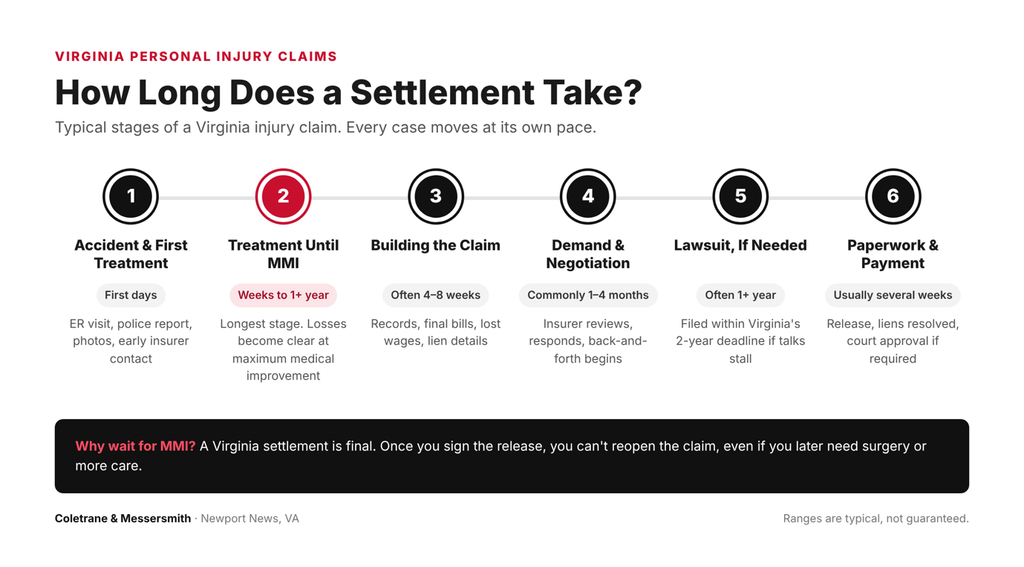
Every case moves at its own pace, so treat these as typical ranges rather than promises.
- Stage 1: The accident and first treatment (the first days). ER visit, police report, photos, and early insurance contact.
- Stage 2: Medical treatment until maximum medical improvement (weeks to a year or more). The longest and least predictable stage.
- Stage 3: Building the claim (often 4 to 8 weeks after treatment ends). Gathering records, final bills, wage documentation, and lien information.
- Stage 4: Demand and negotiation (commonly 1 to 4 months). The insurer reviews the demand and responds, and the back-and-forth begins.
- Stage 5: Lawsuit, if needed (often a year or more in circuit court). Filed within Virginia’s two-year deadline when negotiation stalls.
- Stage 6: Paperwork and payment (usually several weeks). Release signed, liens resolved, court approval where required, funds disbursed.
Why Maximum Medical Improvement Matters So Much
Maximum medical improvement, or MMI, is the point where your doctors say you’ve recovered as much as you’re likely to. You might be fully healed. You might be left with a limp, chronic pain, or a shoulder that will never lift past a certain height. Either way, MMI is the moment your losses become knowable.
That matters because a Virginia settlement is final. When you sign the release, you give up the right to come back for more money, even if your condition gets worse next year. Suppose you settle two months after a rear-end collision because the adjuster’s offer covers your bills so far. Then the MRI you’d been putting off shows a herniated disc, and your orthopedist recommends surgery. That surgery, the time off work, and the months of rehab are now yours to pay for. The claim is closed.
Waiting for MMI also gives your doctors time to put opinions on paper about future care, permanent restrictions, and how the injury affects your ability to work. Those opinions are often what separate a modest settlement from one that genuinely accounts for the rest of your life.
There’s one exception to the “wait” advice. If MMI is going to take a very long time, as with a traumatic brain injury or a recovery involving several surgeries, your attorney will keep an eye on the two-year statute of limitations and may file suit to protect the claim while treatment continues. Waiting for MMI never means letting the deadline slip by.
What Can Slow a Settlement Down
- Disputed fault: Under Virginia’s contributory negligence rule, if the insurer believes you were even slightly to blame, it may deny the claim outright. A case with a real fault dispute almost always takes longer.
- Serious or permanent injuries: The larger the claim, the harder the insurer looks at it. Expect more record requests, and possibly an independent medical exam, before any meaningful offer comes in.
- Multiple parties or policies: A crash involving a commercial truck, a rideshare driver, or several vehicles brings more insurers and more lawyers into the conversation, and each one wants its own review.
- Low policy limits: When the at-fault driver carries only Virginia’s minimum coverage of $50,000 per person, you may need to make a claim against your own underinsured motorist coverage, which adds another step.
- Liens: Health insurers, Medicare, Medicaid, and hospitals may all claim part of the settlement for what they paid. Negotiating those claims down takes time, but it often puts real money back in your pocket.
- Gaps in treatment: Missed appointments give the adjuster a reason to argue your injuries weren’t serious, which tends to drag out negotiation rather than speed it up.
What Can Help a Case Move Faster
You can’t control the insurer, but you can control a lot about how ready your claim is. Keep every appointment and follow through on referrals. Save receipts, mileage, and pay stubs in one folder. Don’t post about the accident or your recovery on social media. And bring in a personal injury lawyer early, before you give a recorded statement, so evidence such as video footage and vehicle data is preserved while it still exists.
When a Lawsuit Becomes Part of the Timeline
Filing suit doesn’t mean your case will end up in front of a jury. Most lawsuits still settle, often after both sides have exchanged evidence and taken depositions. But it does change the calendar.
In Virginia, injury claims up to $50,000 can be filed in General District Court, which tends to move faster and with less formal discovery. Larger claims go to circuit court, where the path from filing to trial commonly runs a year or more, depending on the court’s docket. Settlements for children and wrongful death settlements also need a judge’s approval before they’re final, which adds a short hearing to the end of the process.
A personal injury lawyer who is prepared to try the case often gets a better result at the negotiating table, because the insurer knows the delay won’t pressure you into accepting a low number.
Getting Paid After You Settle
Once both sides agree on a figure, the insurer sends a release to sign. After it’s returned, payment typically arrives within a few weeks and goes into the law firm’s trust account. From there, liens and case costs are paid, and the remaining balance is disbursed to you with a written breakdown of every deduction.
Waiting on a Settlement? We’ll Keep Your Claim Moving
At Coletrane & Messersmith, we don’t let cases sit, and we don’t push clients to take money before they know what their injuries will cost. We stay in touch with your doctors as you recover, build the demand while treatment winds down, and push the insurer for a timely answer.
If you’re not sure where your claim stands, talk to a personal injury lawyer on our team. The consultation is free, and we’ll give you a realistic picture of how long your case is likely to take and why.


